Text set in serif type with a dotted bar in the margin was drafted by an LLM and sometimes reviewed by the author. The rest is the author's own. How to read this site
msize
20260704_225157_msize · complete · published 2026-07-16 · seed 42
Intent
Run on 2026-07-05 in about 8.1 hours on a single GTX 1660 Ti, training the six widths across the α sweep in sequence: 1,860 models in all (six widths × thirty-one α values × ten seeds), base seed 42, no failures or resumes.
This experiment asks how a model's embedding width, n_embd, affects
whether it learns subject-verb agreement well enough to
generalize to noun-verb pairings it never trained on. It moves
one axis of model capacity and holds the rest fixed. Every
model has two layers and four attention heads, so the only thing that changes
from arm to arm is width, the size of the weight-tied embedding and the
residual stream it feeds.
Background
When n_embd is below the vocabulary size of 167, the weight-tied
embedding cannot give each token its own direction and has to pack them into
shared ones, which should force more distributed representations.
Hypothesis
The prediction is that peak unseen_mismatch accuracy falls as width shrinks, and that at some narrow width agreement generalization fails outright. Every arm holds depth at two layers, four heads, the 1200-iteration budget, and the 6e-4 learning rate fixed, so parameter count is the only variable.
Setup
| arm | n_embd | n_layer | n_head | ~params |
|---|---|---|---|---|
| n-embd_016 | 16 | 2 | 4 | 10,064 |
| n-embd_032 | 32 | 2 | 4 | 32,416 |
| n-embd_064 | 64 | 2 | 4 | 113,984 |
| n-embd_128 | 128 | 2 | 4 | 424,576 |
| n-embd_256 | 256 | 2 | 4 | 1,635,584 |
| n-embd_512 | 512 | 2 | 4 | 6,416,896 |
data regime (all arms): single-dataset-recycled — 1 dataset(s) × 1200 iters each = 4.0 epochs per dataset
Replicate this experiment
Get the code at this exact version:
git clone https://github.com/ClaireHobbs/imagining-syntax
cd imagining-syntax
git checkout a405b62
pip install -e ".[dev]"
Download the config (experiment.yaml) and run:
imsyn exp run experiment.yamlChecks
PASS children_complete PASS replicate_coverage PASS instrument_consistent
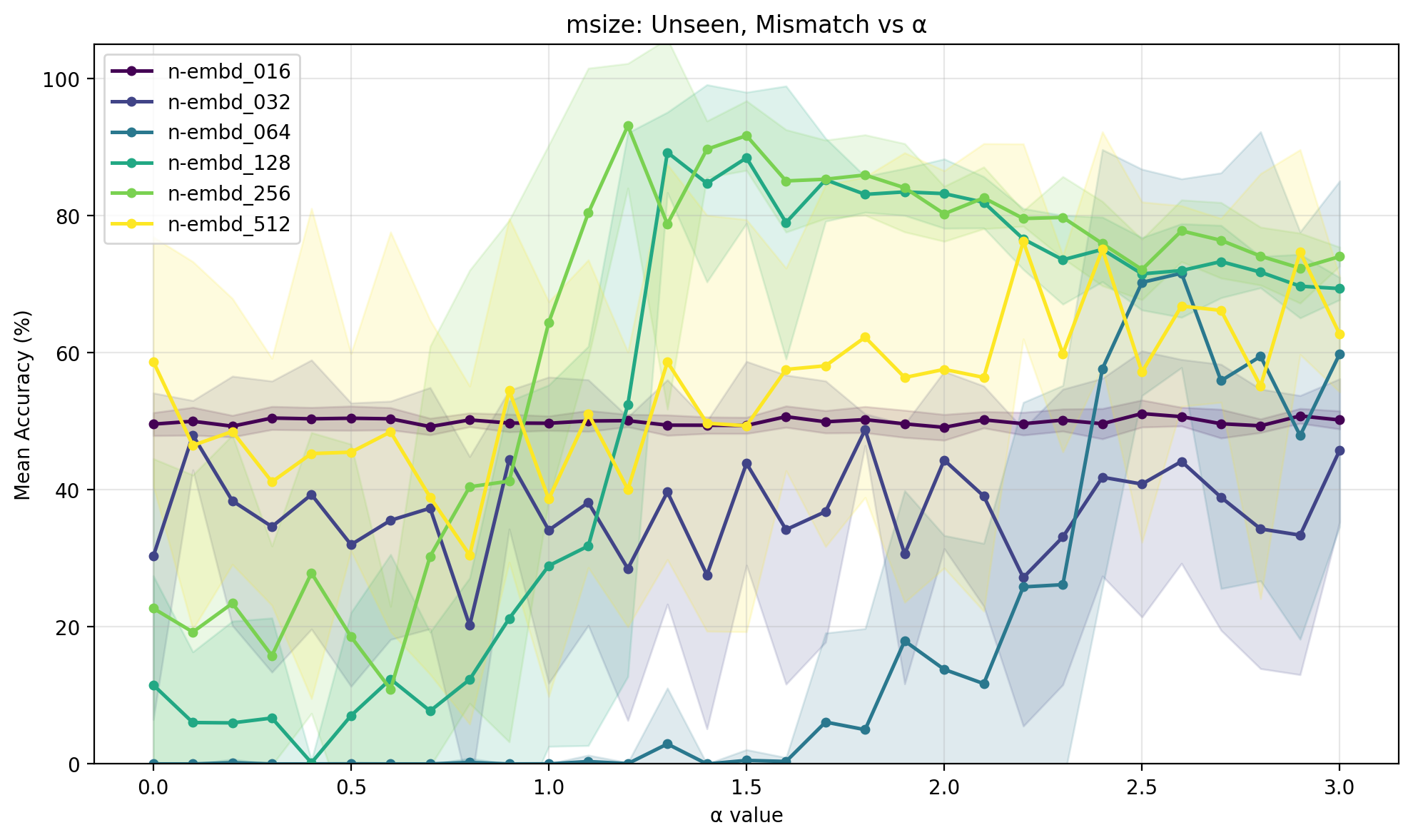
Results — unseen_mismatch (mean ± sd over 10 seeds)
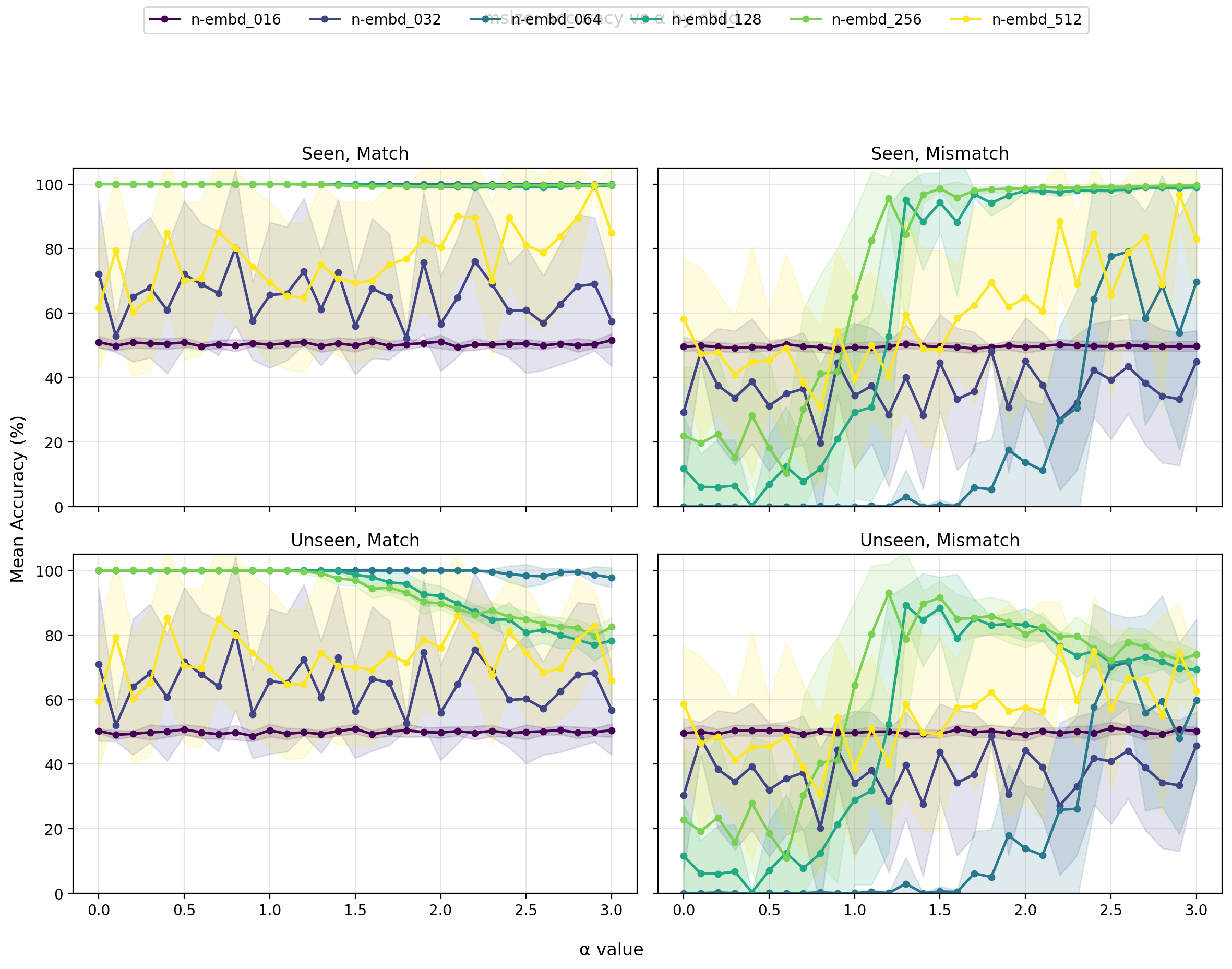
Evaluation data: seen_* generated at each grid point's own training α · unseen_* = held-out pairings, uniform (α-independent) · 1000 pairs per condition
- Each probe is a minimal pair: a grammatical sentence and its verb-number-flipped twin. The model scores correct when it assigns the grammatical version higher probability; accuracy = % correct over 1000 pairs per condition.
- seen_match / seen_mismatch — noun–verb pairings that occur in training, sampled at the same α the model was trained on (matched per grid point, so this eval data varies with the training α)
- unseen_match / unseen_mismatch — held-out noun–verb pairings that never occur in training, sampled uniformly (α = 0), so their difficulty is identical across all arms and training αs
- match vs mismatch — whether the prepositional objects agree in number with the subject; mismatch places attractor nouns between subject and verb (the AGREE-RECENT trap)
| arm | peak over α (end of training) | per-seed | flags |
|---|---|---|---|
| n-embd_016 | 51.1 ±2.0 @ α=2.5 | ||
| n-embd_032 | 48.7 ±2.3 @ α=1.8 | ||
| n-embd_064 | 71.6 ±13.8 @ α=2.6 | ||
| n-embd_128 | 89.2 ±5.9 @ α=1.3 | ||
| n-embd_256 | 93.1 ±9.1 @ α=1.2 | ||
| n-embd_512 | 76.2 ±14.2 @ α=2.2 | ⚠ seed_split: range 48.2-90.8 (2 low / 4 high of 10) |
Conclusions
The hypothesis is partly borne out. There is a capacity floor below which the model learns no agreement, and across the lower and middle of the width ladder peak accuracy does fall as width shrinks. What the hypothesis did not anticipate is that the ladder is a sequence of qualitatively different solutions rather than one curve that degrades smoothly, and that the widest model breaks the upward trend instead of extending it.
Referenced by (1 direct)
Direct references:
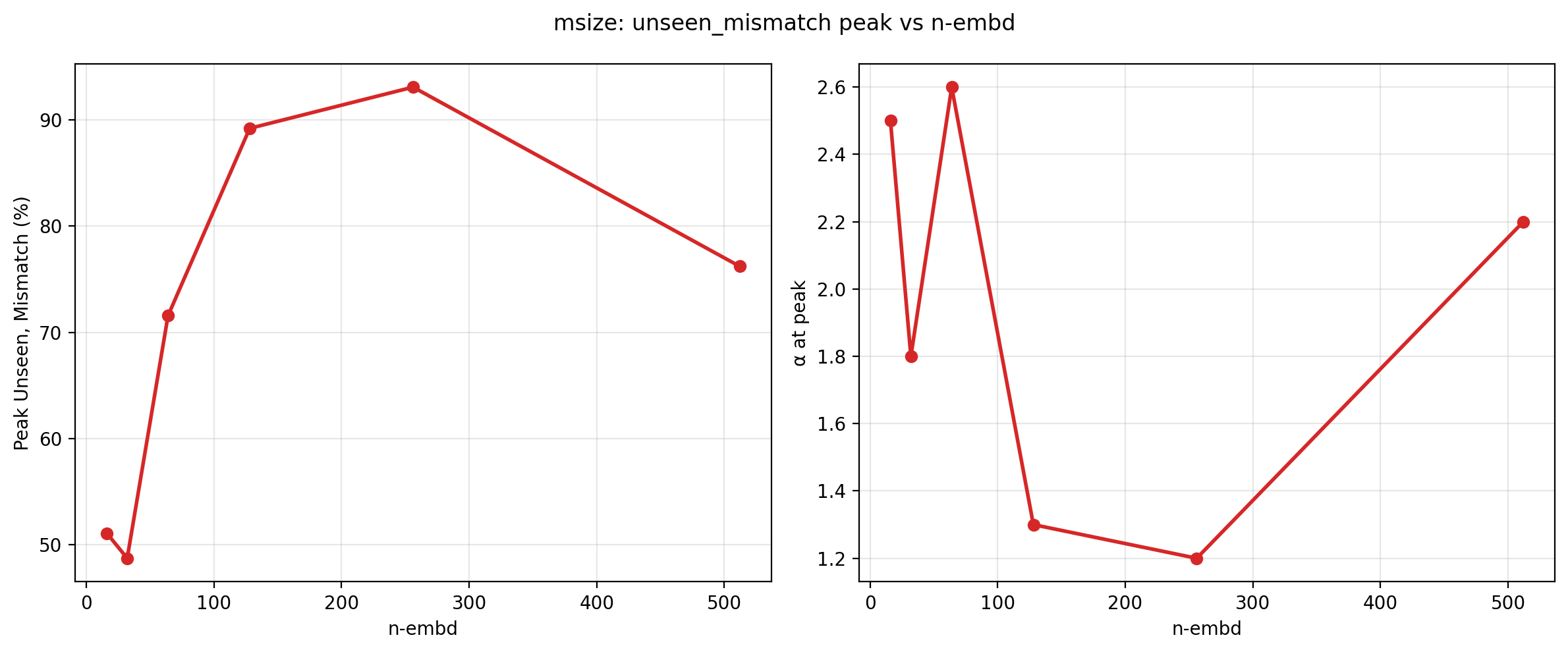
Peak unseen_mismatch, the hardest condition and the one the experiment is read through, summarizes each width. The value is the mean over ten seeds at the α where that mean is highest.
n_embd |
approx params | peak unseen_mismatch |
peak α | solution |
|---|---|---|---|---|
| 16 | 10,064 | 51.1 | 2.5 | no agreement; chance on all four conditions at every α |
| 32 | 32,416 | 48.7 | 1.8 | the nearest-noun shortcut in some seeds, chance in the rest |
| 64 | 113,984 | 71.6 | 2.6 | shortcut at spread pairings, agreement at concentrated ones |
| 128 | 424,576 | 89.2 | 1.3 | agreement, high and consistent across seeds |
| 256 | 1,635,584 | 93.1 | 1.2 | agreement, the highest peak; little gain over 128 |
| 512 | 6,416,896 | 76.2 | 2.2 | non-monotonic; the seeds split between the two solutions |
The two narrowest widths sit at or below the shortcut. Width 16, at about ten
thousand parameters, stays at chance on all four conditions across the whole
α sweep: seen_match 51.5, seen_mismatch 50.4, unseen_match 50.9,
and unseen_mismatch 51.1, each within a point or two of the 50
chance line and none tracking α, so its peak α of 2.5 is only where sampling
noise happened to land. It has too few parameters to represent either
agreement or the shortcut. Width 32 is the first with enough capacity for a
number-copying rule, but the rule it finds is recency, agreeing
with the nearest noun rather than with the subject. Its match conditions rise
to about 80 (seen_match 80.3 and unseen_match 80.5, both
at α = 0.8) while its mismatch conditions never clear chance, with peaks
of 48.2 and 48.7 and values near 20 at the α where match peaks, because the
recency seeds score 0 there. That 80 is a seed split rather than a
typical run: at α = 0.8 six of the ten seeds copy the nearest noun, scoring
100 on match and 0 on mismatch, and the other four sit at chance on
everything, which the report flags on both match conditions (4 low / 6 high
of 10).
Width 64 is where a phase transition in α appears. At spread-out
pairings, α from 0 up to about 1, the match conditions are
perfect and both mismatch conditions are 0: the model copies the nearest noun
exactly, so it passes every match probe and fails every
mismatch one. As α rises past about
2 the mismatch accuracy climbs, reaching 71.6 unseen_mismatch and
79.0 seen_mismatch at α = 2.6. Width 64 can therefore represent
agreement, but only when the training pairings are concentrated enough to
push it off the shortcut; on spread pairings it reverts. The flip is
incomplete even at its best, with seen_mismatch at α = 2.6 flagged
as a seed split (range 49.7 to 98.7, 3 low / 5 high), so some seeds have
crossed to agreement while others remain on recency.
The next two widths learn agreement outright, and the return to added width
narrows. Width 128 reaches 89.2 unseen_mismatch at α = 1.3 with
every seed between 79.6 and 97.7 and no split, alongside perfect match
conditions and 99.0 seen_mismatch. The transition that width 64
reached only at α = 2.6 now sits at α = 1.3, so more capacity buys the same
rule at less concentrated data. Width 256, the
paper's default, posts the
ladder's highest peak, 93.1 unseen_mismatch at α = 1.2, with 99.6
seen_mismatch and perfect match conditions. The gain over width 128
is about four points, and the spread is a little wider, with one seed at 69.8
lifting the standard deviation to 9.1, so doubling the width from 128 to 256
adds a few points rather than another rung.
The widest model does not continue the climb.
Width 512 peaks at 76.2
unseen_mismatch at α = 2.2, below both 256 and 128, and the
shortfall is a seed bimodality rather than an even decline. At the peak α of
2.2 the ten seeds run from 48.2 to 90.8 with two at chance (flagged 2 low / 4
high). The split is sharper at α = 1.0, where the per-seed values are 48.4,
49.8, 95.3, 45.8, 0.0, 48.3, 0.0, 48.3, 50.3, and 0.0: three seeds have
collapsed onto the shortcut, one has reached 95.3, and the rest sit at
chance, spanning 0.0 to 95.3 with a standard deviation of 28.8.
Referenced by (6 direct, 4 transitive)
Direct references:
The seen
conditions stay high (seen_match 99.7, seen_mismatch
96.7) while both unseen conditions split (unseen_match 86.0,
unseen_mismatch 76.2), so it is specifically generalization to
unseen pairings that has become seed-dependent. At the
fixed 1200-iteration budget the widest model does not
reliably choose agreement over the
shortcut; which one a run lands on depends on its seed. Whether that
reflects undertraining, the confound that comes with holding the step
budget fixed across arms, or a genuine instability of the overparameterized
model is the open question the follow-ups address.
Read against the hypothesis, the capacity floor is real and the predicted fall with shrinking width holds from 256 downward (93.1, then 89.2, 71.6, and chance at 32 and 16).
Referenced by (8 direct, 3 transitive)
Direct references:
The two parts the data does not support are the shape
at the top and the location of the boundary. The widest model is worse than
the paper's default rather than better or equal, so peak accuracy is not
monotone in width. And the compression argument pointed to a boundary where
n_embd crosses the vocabulary size of 167, between widths 128 and
256, but the curves show no discontinuity there; the qualitative changes all
happen much lower, at 16, 32, and 64.
What moves smoothly instead is the transition α: narrower models need more concentrated pairings to leave the shortcut (64 at α ≈ 2.6, 128 at 1.3, 256 at 1.2), so within this range capacity and distributional concentration are partly interchangeable.
One caution about the figures. The peak-versus-width figure
(images/peak_vs_n-embd.png) plots each width's mean, and for width
512 that mean falls in the empty gap between the two seed groups, describing
no actual run. Read it together with the per-seed values rather than on its
own.
Two threads follow from the width-512 result:
- A waypoint or continued run at width 512, with width 256 as a control, would separate undertraining from instability. If the split closes with more training, the fixed budget was the cause.
- A per-seed analysis at the two transition regions, width 512 near α = 1.0 and width 64 near α = 2.0 to 2.4, would connect this seed split to the recency-bimodality work, since those are the α where seeds divide between the shortcut and agreement.
Comparison figures
Children
| Child | n-embd | peak unseen_mismatch | Status |
|---|---|---|---|
| n-embd_016 | 16 | 51.1 | done |
| n-embd_032 | 32 | 48.7 | done |
| n-embd_064 | 64 | 71.6 | done |
| n-embd_128 | 128 | 89.2 | done |
| n-embd_256 | 256 | 93.1 | done |
| n-embd_512 | 512 | 76.2 | done |