Text set in serif type with a dotted bar in the margin was drafted by an LLM (claude-fable-5) and sometimes reviewed by the author. The rest is the author's own. How to read this site
schedopt_bo_r6
20260722_132509_schedopt_bo_r6 · complete · published 2026-07-23 · seed 1000
part of investigation alpha-curriculum → schedule-opt → schedopt-v2
Intent
Step E of the schedopt re-freeze continuation (Phase 4), round 6: eight candidate schedules from the four-parameter modulation family, the three-parameter ramp multiplied by (1 + A·w) with amplitude A in [0, 1] and w pinned to burst_16's realized tooth wave (period 400/3 steps, duty 0.5, peak-first), proposed by Thompson sampling from a Gaussian process warm-started from every three-parameter evaluation re-expressed at A = 0 and scored at the re-frozen operating point v2 (m_star=95.5, k=350, dwell 2) over the shared search seed pool. The pre-registration (experiments/schedopt/phase4_prereg.md) precedes every run of this phase; v1 and v2 numbers are never merged.
Hypothesis
At least one modulated candidate beats the best smooth schedule on the search pool, and the running optimum's amplitude A is greater than zero. Search-phase s-hat values are never reported as results.
Setup
data regime (all arms): fresh-dataset-per-stage — 14 dataset(s) × 25 iters each = 0.02 epochs per dataset
Replicate this experiment
Get the code at this exact version:
git clone https://github.com/ClaireHobbs/imagining-syntax
cd imagining-syntax
git checkout a35464c3d0aa
pip install -e ".[dev]"
Download the config (experiment.yaml) and run:
imsyn exp run experiment.yamlChecks
PASS children_complete PASS replicate_coverage PASS schedule_total_matches_final_waypoint PASS instrument_consistent PASS objective_computable
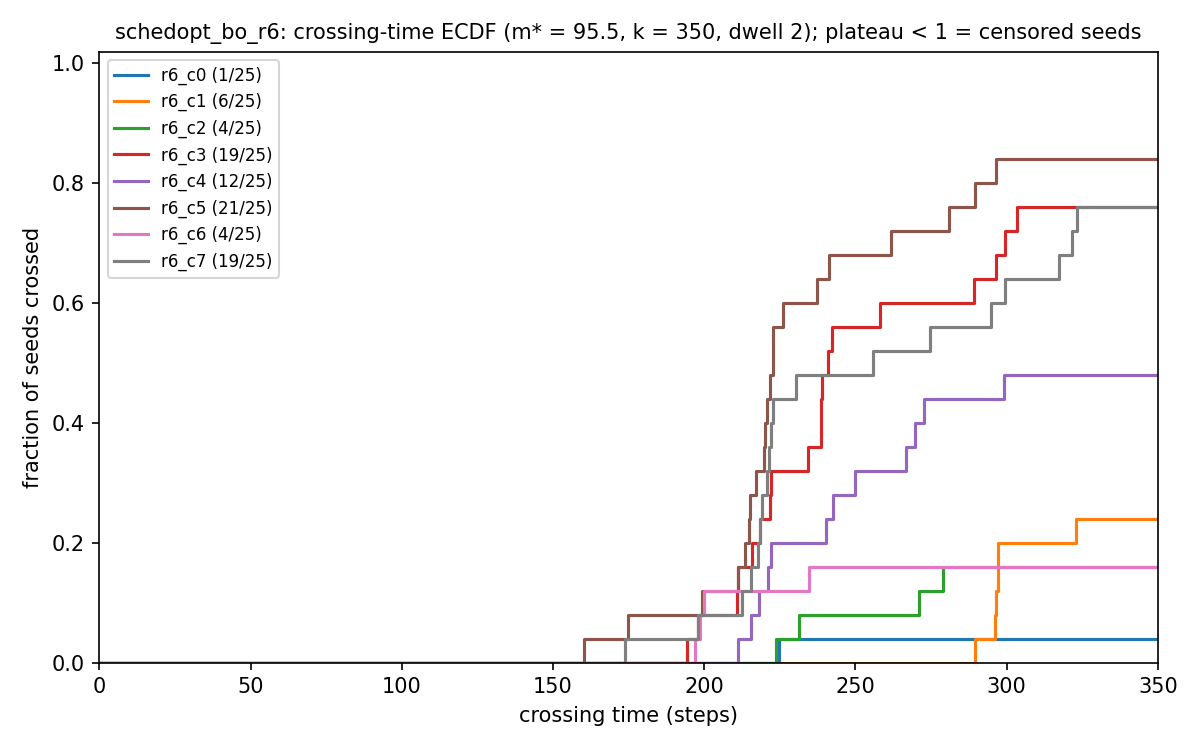
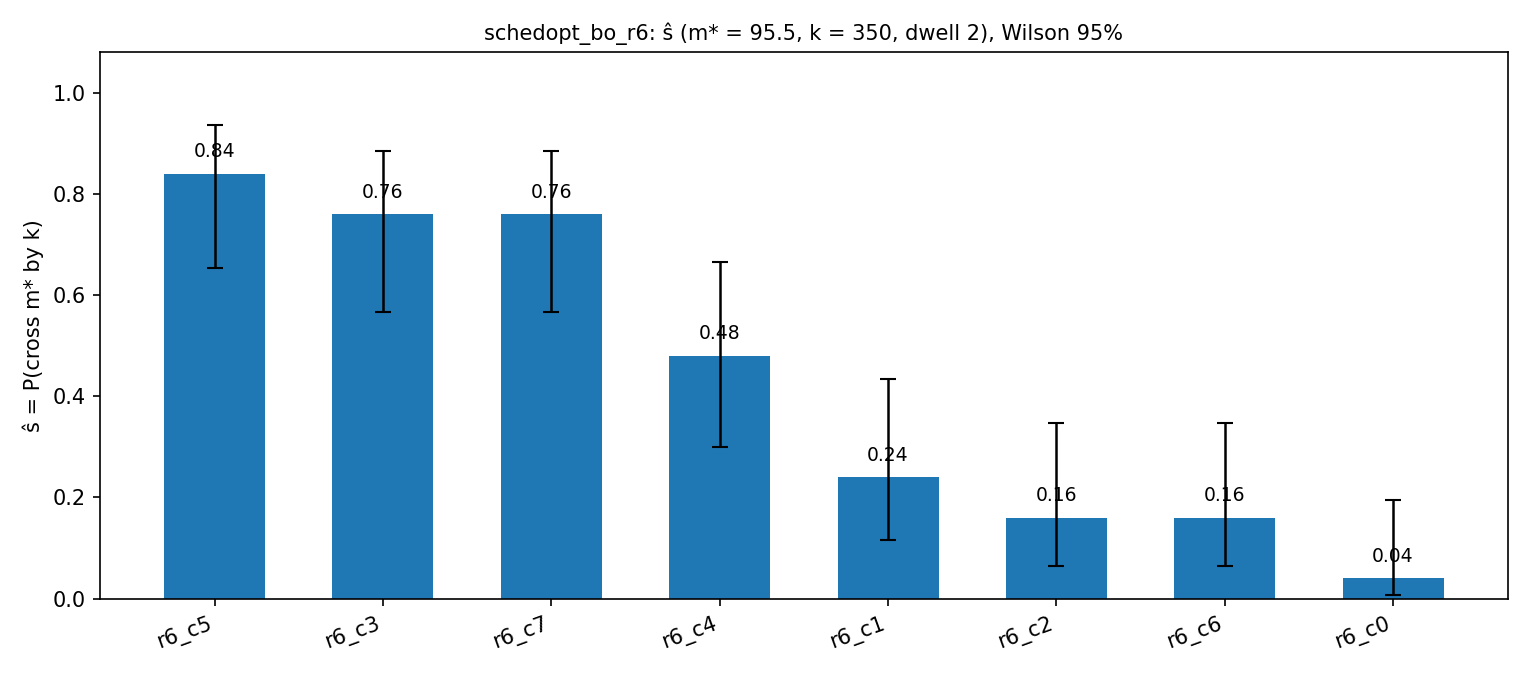
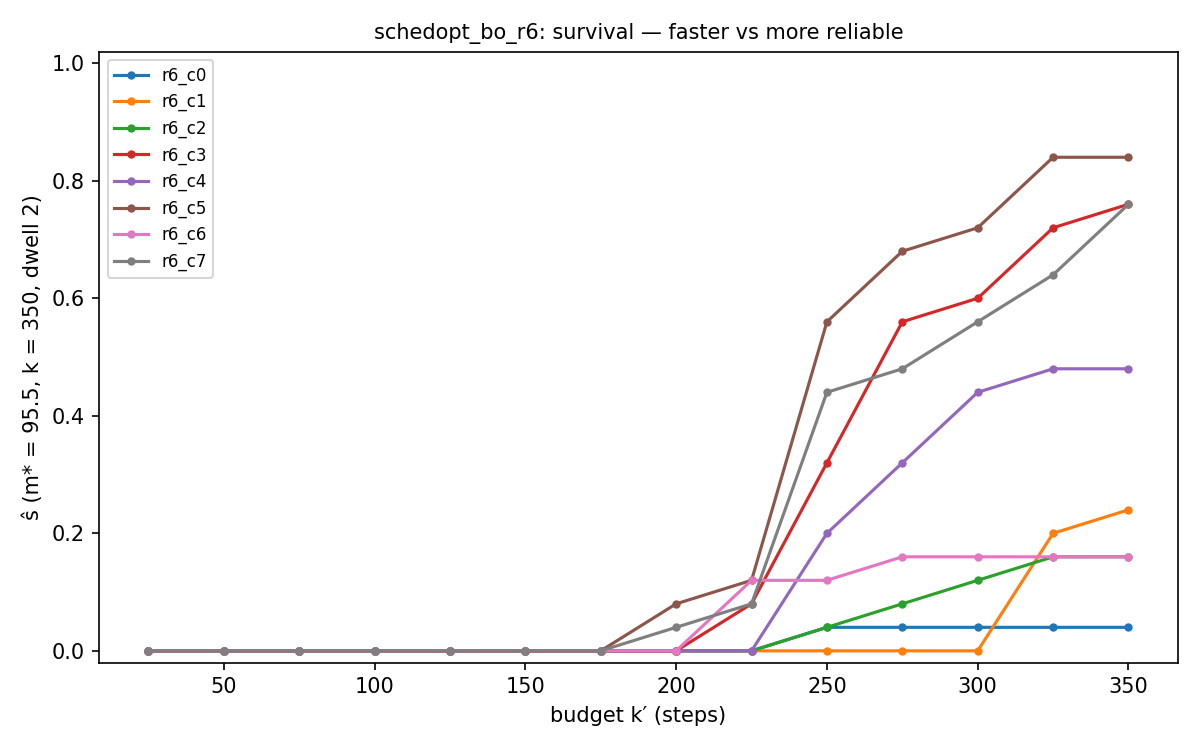
Results — objective: P(unseen_mismatch ≥ 95.5 by t = 350, dwell 2, smoothing 1)
| arm | ŝ | wilson95 | median crossing [CI] | crossed |
|---|---|---|---|---|
| r6_c5 | 0.840 | [0.653, 0.936] | 220.8 [215.3, 229.6] | 21/25 |
| r6_c3 | 0.760 | [0.566, 0.885] | 238.5 [218.6, 242.2] | 19/25 |
| r6_c7 | 0.760 | [0.566, 0.885] | 222.2 [218.3, 274.8] | 19/25 |
| r6_c4 | 0.480 | [0.300, 0.665] | 241.3 [219.6, 269.7] | 12/25 |
| r6_c1 | 0.240 | [0.115, 0.434] | 296.7 [292.9, 310.1] | 6/25 |
| r6_c2 | 0.160 | [0.064, 0.347] | 251.1 [223.6, 278.8] | 4/25 |
| r6_c6 | 0.160 | [0.064, 0.347] | 199.2 [197.1, 234.6] | 4/25 |
| r6_c0 | 0.040 | [0.007, 0.195] | 224.7 [224.7, 224.7] | 1/25 |
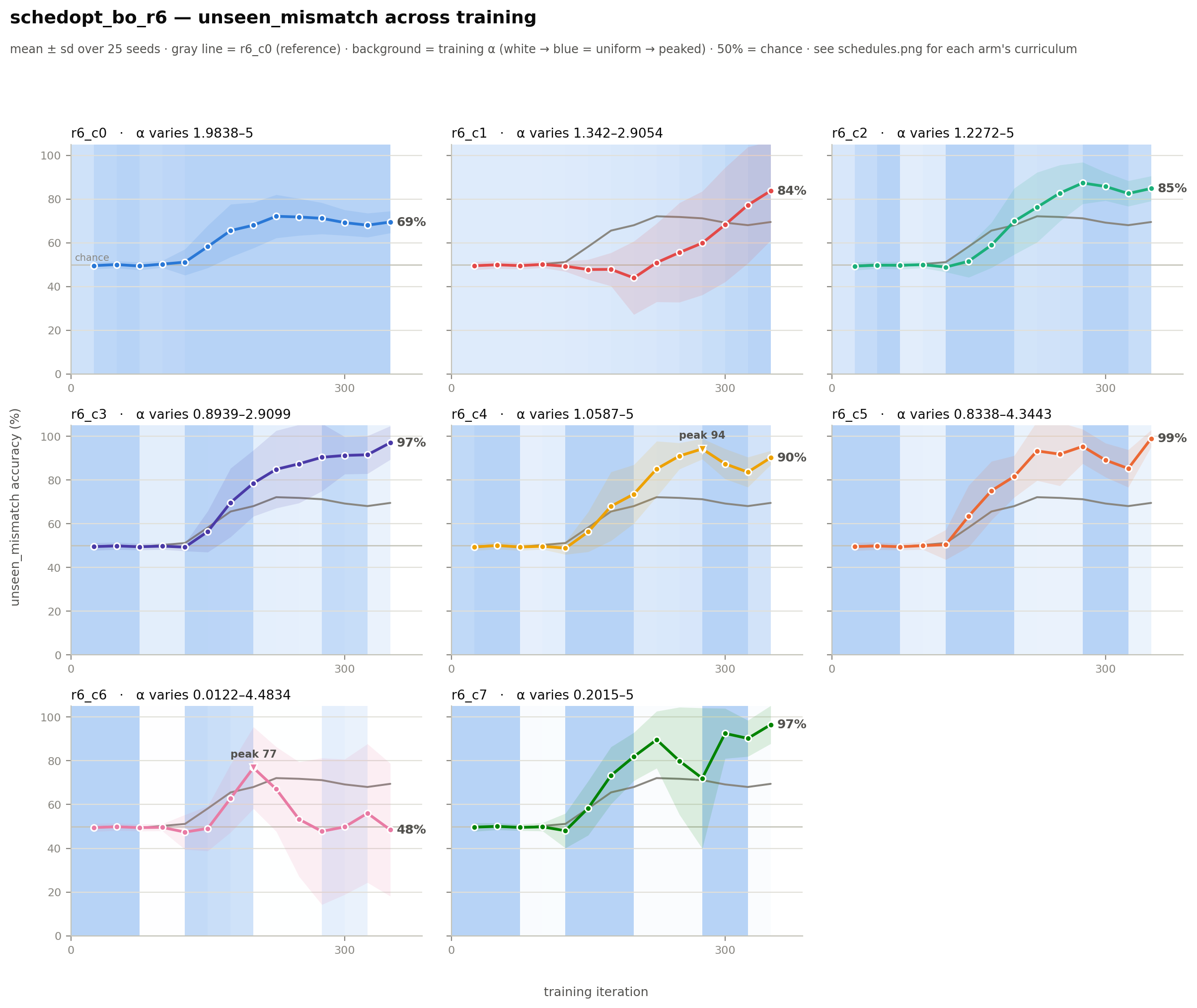
Trajectory summary — unseen_mismatch
Evaluation data: seen_* probed at reference α = 1.4 · unseen_* = held-out pairings, uniform (α-independent) · 1000 pairs per condition
- Each probe is a minimal pair: a grammatical sentence and its verb-number-flipped twin. The model scores correct when it assigns the grammatical version higher probability; accuracy = % correct over 1000 pairs per condition.
- seen_match / seen_mismatch — noun–verb pairings that occur in training, sampled at fixed reference α = 1.4 (not at the schedule's own α, so arms stay comparable)
- unseen_match / unseen_mismatch — held-out noun–verb pairings that never occur in training, sampled uniformly (α = 0), so their difficulty is identical across all arms and training αs
- match vs mismatch — whether the prepositional objects agree in number with the subject; mismatch places attractor nouns between subject and verb (the AGREE-RECENT trap)
| arm | end of training (t = 350) | per-seed | flags |
|---|---|---|---|
| r6_c0 | 69.5 ±5.0 | ||
| r6_c1 | 83.7 ±22.7 | ⚠ seed_split: range 5.5-100.0 (1 low / 13 high of 25) | |
| r6_c2 | 84.8 ±5.7 | ||
| r6_c3 | 97.0 ±7.7 | ||
| r6_c4 | 90.2 ±3.2 | ||
| r6_c5 | 98.9 ±3.9 | ||
| r6_c6 | 48.5 ±30.4 | ⚠ seed_split: range 1.4-100.0 (4 low / 4 high of 25) | |
| r6_c7 | 96.5 ±8.7 |
Conclusions
The first modulated round answers the pre-registered amplitude question in the direction the hypothesis expected, and by a wide margin on the search pool. Three of the eight candidates beat the best smooth schedule, and the near-smooth control in the same batch did not, so the gain tracks the tooth amplitude rather than the ramps it rides on.
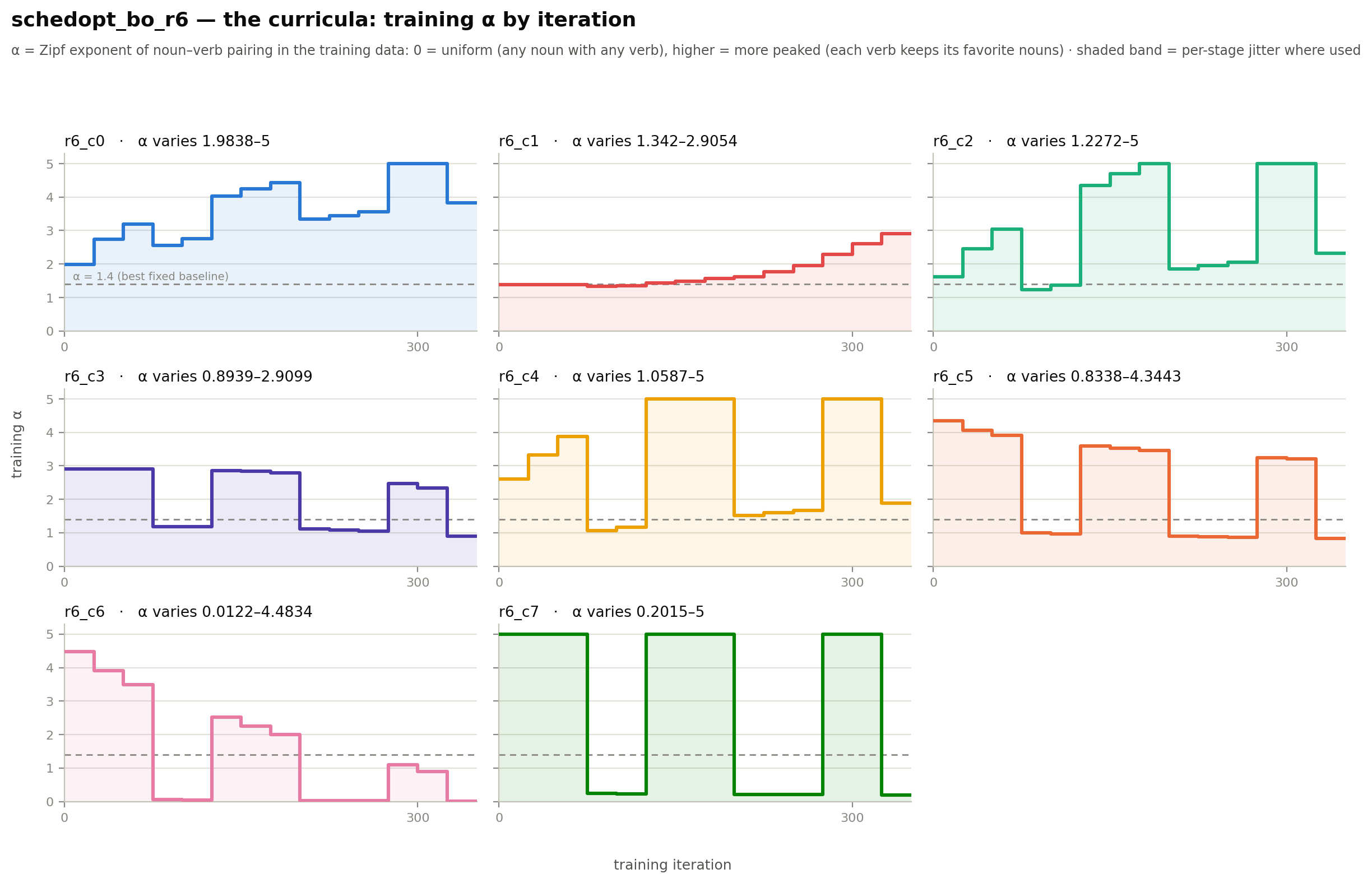
The best candidate, r6_c5 (ramp α 3.22 to 1.98 with early curvature γ 0.29, amplitude A = 0.58), crossed on 0.84 of the pool seeds, Wilson interval 0.65 to 0.94, against 0.52 for the best smooth schedule r3_c5. Two more modulated candidates reached 0.76: r6_c3 (2.05 to 1.48, γ 3.05, A = 0.42) and r6_c7 (4.97 to 3.49, γ 0.44, A = 0.94). The near-smooth probe r6_c1 (A = 0.02) read 0.24, in line with the smooth ascending basin it sits in.
Referenced by (1 direct)
Direct references:
The round also marked out where teeth fail. Full-amplitude teeth on a ramp that descends toward zero (r6_c6, 2.60 to 0.30, A = 0.97) crossed on 0.16 of seeds: with a multiplicative wave, its valleys bottom out near deep-uniform exposure, which the campaign's earlier results already tie to erosion. The winning region instead keeps both the peaks and the valleys inside the productive range. These are search-phase values on the v2 objective, never merged with v1 numbers and not reportable results; the held-out test comes after the search stops.
Comparison figures
Children
| Child | peak unseen_mismatch | Status |
|---|---|---|
| r6_c0 | 72.1 | done |
| r6_c1 | 83.7 | done |
| r6_c2 | 87.3 | done |
| r6_c3 | 97.0 | done |
| r6_c4 | 94.2 | done |
| r6_c5 | 98.9 | done |
| r6_c6 | 76.8 | done |
| r6_c7 | 96.5 | done |