Text set in serif type with a dotted bar in the margin was drafted by an LLM (claude-fable-5) and sometimes reviewed by the author. The rest is the author's own. How to read this site
paper
20260705_105204_paper · complete · published 2026-07-16 · seed 42
Intent
This is the canonical paper reproduction, run fresh on 2026-07-05 through the
packaged bare imsyn entry point. An earlier candidate directory,
paper_20260703_141230, turned out to be the fast smoke run from
rebase validation (Z in {0, 1.4}, one seed) and was archived without
publishing.
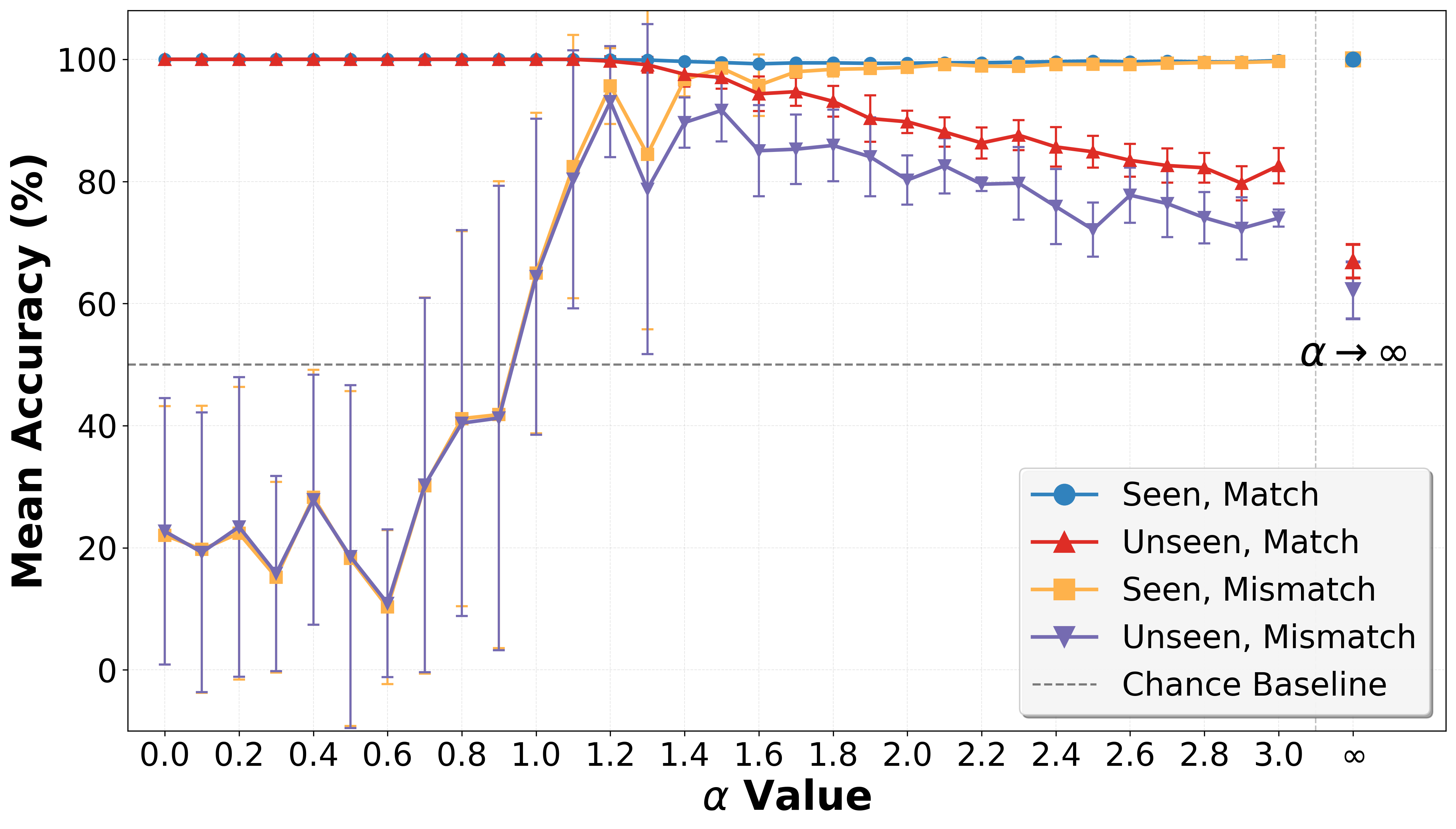
This experiment reproduces the paper's central result, the two panels of Figure 2. It measures how well subject-verb agreement generalizes to noun-verb pairings the model was never trained on as the Zipfian concentration of the training pairings is varied, and it sets that sweep against the oneshot limit, where each verb takes exactly one subject noun. The Zipfian arm sweeps Z from 0.0 to 3.0 in steps of 0.1 with ten seeds at each value; the oneshot arm adds ten more seeds at the deterministic 1:1 limit. Both train the default 256-wide, two-layer, four-head model for 1200 iterations from seed 42.
Background
Hypothesis
The published finding should reproduce. On the hardest condition, unseen_mismatch, accuracy should peak at an intermediate Z rather than rising all the way as the pairings grow more concentrated, and the oneshot limit should generalize worse than the best Zipfian setting even though its pairings are perfectly consistent.
Setup
data regime (all arms): single-dataset-recycled — 1 dataset(s) × 1200 iters each = 4.0 epochs per dataset
Replicate this experiment
Get the code at this exact version:
git clone https://github.com/ClaireHobbs/imagining-syntax
cd imagining-syntax
git checkout 2898aa9
pip install -e ".[dev]"
Download the config (experiment.yaml) and run:
imsyn exp run experiment.yamlChecks
PASS children_complete PASS replicate_coverage PASS instrument_consistent
Results — unseen_mismatch (mean ± sd over 10 seeds)
Evaluation data: seen_* generated at each grid point's own training α · unseen_* = held-out pairings, uniform (α-independent) · 1000 pairs per condition
- Each probe is a minimal pair: a grammatical sentence and its verb-number-flipped twin. The model scores correct when it assigns the grammatical version higher probability; accuracy = % correct over 1000 pairs per condition.
- seen_match / seen_mismatch — noun–verb pairings that occur in training, sampled at the same α the model was trained on (matched per grid point, so this eval data varies with the training α)
- unseen_match / unseen_mismatch — held-out noun–verb pairings that never occur in training, sampled uniformly (α = 0), so their difficulty is identical across all arms and training αs
- match vs mismatch — whether the prepositional objects agree in number with the subject; mismatch places attractor nouns between subject and verb (the AGREE-RECENT trap)
| arm | end of training | per-seed | flags |
|---|---|---|---|
| oneshot | 62.2 ±4.7 | ||
| zipfian | 93.1 ±9.1 @ α=1.2 |
Conclusions
The published result reproduces. On the hardest condition,
unseen_mismatch, mean accuracy peaks at an intermediate Zipfian
concentration and then falls away toward the concentrated end, and
the oneshot limit, where each verb takes exactly one subject noun,
generalizes worse than that peak. The composed two-panel figure is
images/figure_2.png.
Across the sweep, mean unseen_mismatch traces the intermediate
peak the paper describes. At the uniform end it sits near or below the 50
chance line, 22.7 at Z = 0.0 and as low as 10.9 at Z = 0.6. Accuracy below
chance there means the model is agreeing with the nearest
noun instead of the subject, which the matched conditions confirm:
unseen_match and seen_match hold at 100 wherever the
attractors and the subject want the same verb. Accuracy
then rises steeply through Z = 1.0, 1.1, and 1.2 (64.4, 80.3, 93.1), peaks at
93.1 ±9.1 at Z = 1.2, and drifts back down across the concentrated tail to
74.0 at Z = 3.0. The climb is not monotonic in concentration; the best
generalization is in the middle of the range.
Referenced by (9 direct, 10 transitive)
Direct references:
- The best-generalizing α slides with the training budget
- The peak survives every vocabulary; capacity caps its height
- The width ladder climbs through distinct solutions and breaks at 512
- Cached datasets reproduce fresh results
- More training erodes the peak
- curriculum_v1
- The child-directed speech motivation
- What the reproduction established
- The intermediate peak is real but it is a slice of a moving target
Transitive (depth 1):
- Width-axis counterpart to depth_long
- More training does not settle the wide model
- Width and depth are different axes, and bigger is not better
- The published result reproduces and separates memory from rule
- A robust peak whose location is set by the budget
- The coarse grid left the peak timing open
- Peak timing splits into three regimes and arrives earlier with Z
- Capacity is already binding at vocabulary 120
- The scaling series varies vocabulary at a fixed quarter
Transitive (depth 2):
The peak carries real spread across replicates. Its ten seeds run from 69.8 to 100.0, half of them at 98 or above, so the 93.1 mean sits below the seeds that fully solved the task and is held down by the few that did not.
The oneshot limit shows what perfect consistency buys and what it costs.
Both seen conditions are exactly right, seen_match and
seen_mismatch at 100.0 ±0.0, so the model handles the attractor trap
on the pairings it trained on. On held-out pairings, though, it
reaches only 62.2 ±4.7 on unseen_mismatch and 66.9 ±2.7 on
unseen_match. That is memory of consistent pairings rather than a
rule that transfers, and 62.2 sits below the Zipfian peak of 93.1 and below
the mean at every swept Z from 1.0 upward. The most concentrated regime is
not where agreement generalizes best.
Referenced by (2 direct)
Put side by side, the two panels separate memory from rule. As the pairings
concentrate the model memorizes the trained material better:
seen_mismatch improves from 22.0 at Z = 0.0 to 99.6 at Z = 3.0 and
100.0 at oneshot, while seen_match stays near 100 throughout.
Generalization to unseen pairings runs the other way, weakening through the
tail: unseen_match falls from 100 at low Z to about 82.6 at Z = 3.0
and 66.9 at oneshot, and unseen_mismatch turns over at Z = 1.2. The
intermediate setting is where the training pairings vary enough to rule out
memorization yet stay regular enough to learn from, which is the paper's
account of why pairing variability forces an abstract agreement
rule.
Referenced by (1 direct)
Direct references:
Two things bear on how firmly to read the peak's location. Its exact position in Z is partly a property of the 1200-step snapshot rather than a fixed feature of the grammar: the companion long-iteration and peak-timing runs (paper_long_iter, peak_umm_iter) show higher-Z settings peaking earlier and then drifting, so Figure 2's shape is best read together with those. The peak itself reproduces independently, appearing at the same 93.1 at Z = 1.2 in the msize d = 256 run on this grid under the same seed policy.
Comparison figures
Children
| Child | peak unseen_mismatch | Status |
|---|---|---|
| zipfian | 93.1 | done |
| oneshot | 62.2 | done |