Text set in serif type with a dotted bar in the margin was drafted by an LLM (claude-opus-4-8) and sometimes reviewed by the author. The rest is the author's own. How to read this site
curriculum_v1
20260711_172518_curriculum_v1 · complete · published 2026-07-16 · seed 42
Intent
The paper trains each model at a single fixed pairing distribution.
This experiment asks whether varying that distribution over the course of one run does better. Concretely, does annealing the Zipfian exponent α from peaked toward uniform within a single 1200-iteration run beat the best fixed setting, α = 1.4, at the same training budget?
Background
The peaked-to-uniform shape mirrors child-directed speech, whose measured α falls from about 1.46 to 1.25 over the first 96 months.
The paper's best fixed α is 1.4.
Hypothesis
The proposed mechanism is collocational bootstrapping. Early training at high α, where each verb almost always takes its favorite noun, should build strong associations from a verb to its subject, so the model learns to agree with the subject rather than with the nearest noun. The later low-α tail, where pairings spread out, should then force the model to abstract agreement across the whole noun class. If this holds, a curriculum arm (cds or anneal_3_0) should beat both fixed baselines on unseen_mismatch at iteration 1200: fixed_14_single, the paper's best fixed α, and fixed_14_fresh, which draws fresh data each stage at constant α and controls for data diversity. The anti-curriculum arm reverse_0_3 should not beat them, and noisy_14 controls for variability without a trend.
Curricula
Every arm trains for 1200 steps in eight 150-step
segments, and each segment draws a fresh
12,000-sentence dataset at its own α. What
differs between arms is the sequence of αs. Higher α makes each verb's
subject more predictable; α = 1.4 is
the paper's best fixed setting, and it is the
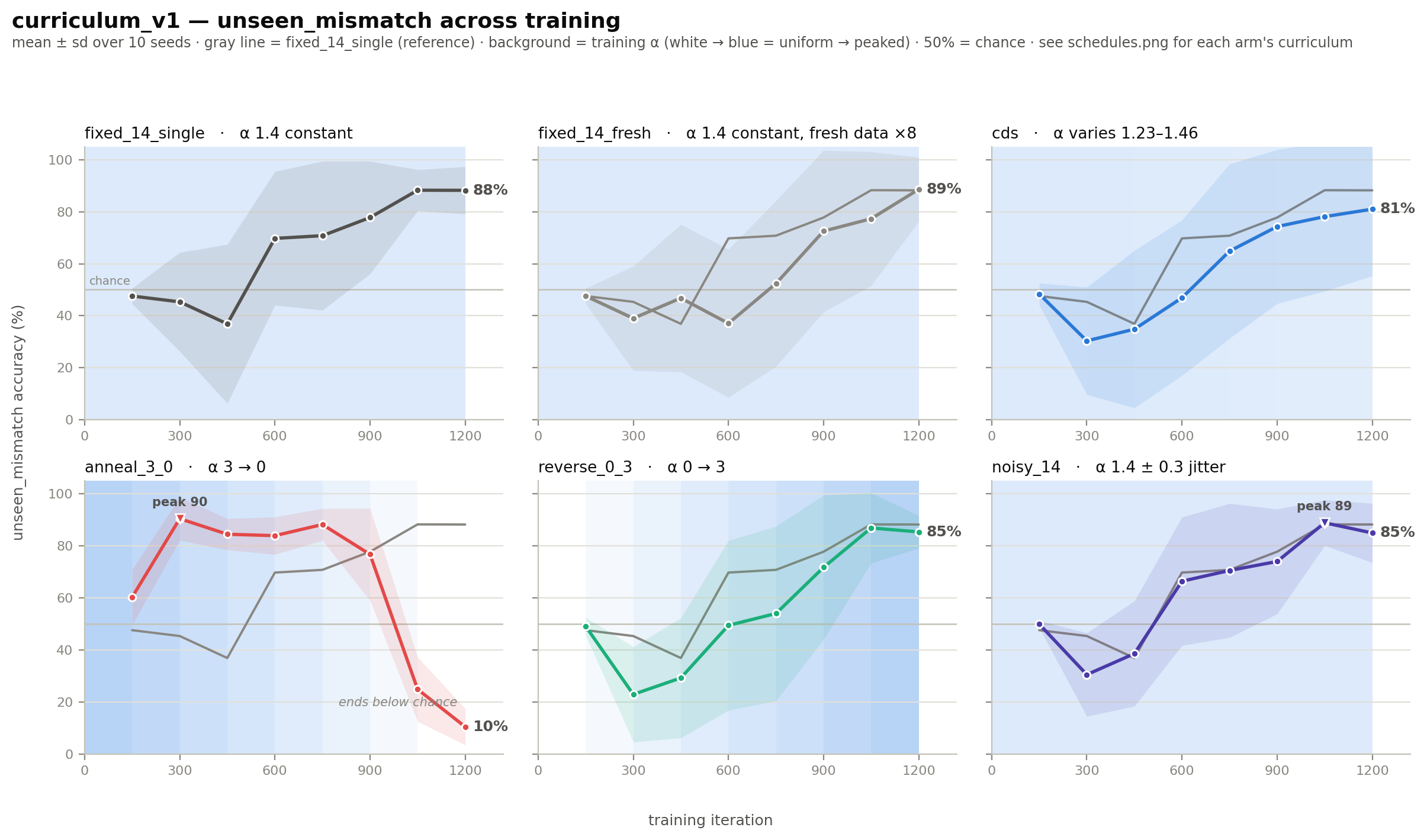
baseline every arm is measured against (the gray line in images/curriculum_comparison.png;
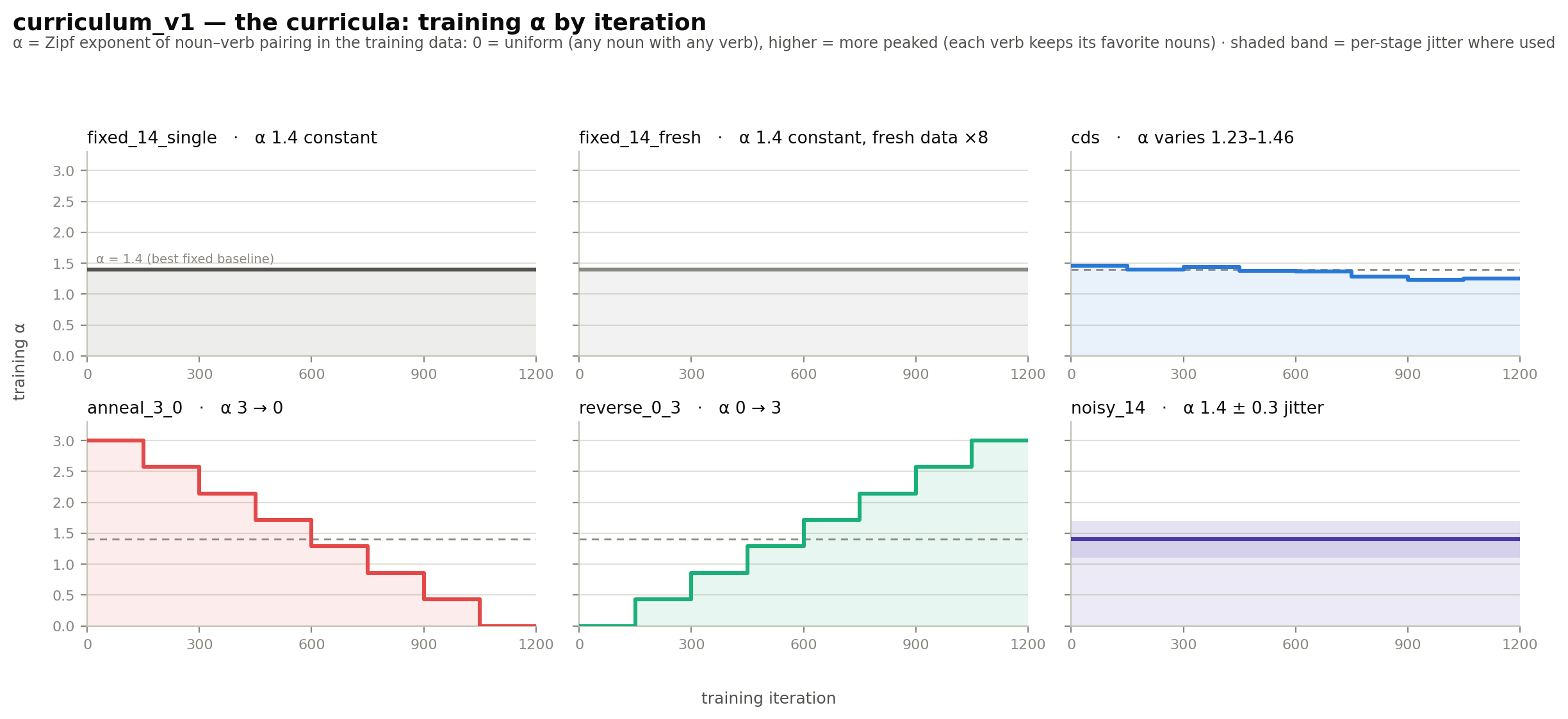
each arm's α over training is in images/schedules.png).
- fixed_14_single: α = 1.4 throughout, on one dataset for the whole run. This is the paper's original setup and the strongest fixed baseline.
- fixed_14_fresh: α = 1.4 throughout, but with a fresh dataset every 150 steps. It controls for data freshness, so a curriculum win has to beat varied data at a constant α, not merely varied data.
- cds: the eight stage αs are the values measured in child-directed speech by child age (1.46, 1.40, 1.44, 1.38, 1.37, 1.28, 1.23, 1.25 for ages 0 to 96 months). A gentle, realistic drift that stays near 1.4.
- anneal_3_0: a linear annealing from very peaked to fully uniform (3.0, 2.57, 2.14, 1.71, 1.29, 0.86, 0.43, 0.0). The strong form of the curriculum: build the collocations first, then force generalization.
- reverse_0_3: the same ladder run backwards, from uniform up to very peaked. The anti-curriculum control.
- noisy_14: α = 1.4 at every stage with Gaussian jitter (σ = 0.3, redrawn per stage and per seed). It controls for variability without a trend.
Setup
| arm | data regime | datasets | iters/dataset | epochs/dataset |
|---|---|---|---|---|
| anneal_3_0 | fresh-dataset-per-stage | 8 | 150 | 0.5 |
| cds | fresh-dataset-per-stage | 8 | 150 | 0.5 |
| fixed_14_fresh | fresh-dataset-per-stage | 8 | 150 | 0.5 |
| fixed_14_single | single-dataset-recycled | 1 | 1200 | 4.0 |
| noisy_14 | fresh-dataset-per-stage | 8 | 150 | 0.5 |
| reverse_0_3 | fresh-dataset-per-stage | 8 | 150 | 0.5 |
Replicate this experiment
Get the code at this exact version:
git clone https://github.com/ClaireHobbs/imagining-syntax
cd imagining-syntax
git checkout 74aeefb
pip install -e ".[dev]"
Download the config (experiment.yaml) and run:
imsyn exp run experiment.yamlChecks
PASS children_complete PASS replicate_coverage PASS schedule_total_matches_final_waypoint PASS instrument_consistent
Claims
| claim | source | expectation | Δ | seeds | verdict |
|---|---|---|---|---|---|
| anneal_beats_single translated | manifest | anneal_3_0 > fixed_14_single on unseen_mismatch @ final | -77.8 | 0/10 | rejected |
| anneal_beats_fresh translated | manifest | anneal_3_0 > fixed_14_fresh on unseen_mismatch @ final | -78.2 | 0/10 | rejected |
| cds_beats_single translated | manifest | cds > fixed_14_single on unseen_mismatch @ final | -7.2 | 6/10 | mixed mean says rejected, seeds 6/10 |
| cds_beats_fresh translated | manifest | cds > fixed_14_fresh on unseen_mismatch @ final | -7.6 | 5/10 | mixed mean says rejected, seeds 5/10 |
| reverse_does_not_win translated | manifest | reverse_0_3 < fixed_14_single on unseen_mismatch @ final | -2.8 | 6/10 | mixed mean says held, seeds 6/10 |
| noisy_neutral translated | manifest | noisy_14 ~= fixed_14_single (±5) on unseen_mismatch @ final | -3.2 | 1/10 | mixed mean says held, seeds 1/10 |
Results — unseen_mismatch (mean ± sd over 10 seeds)
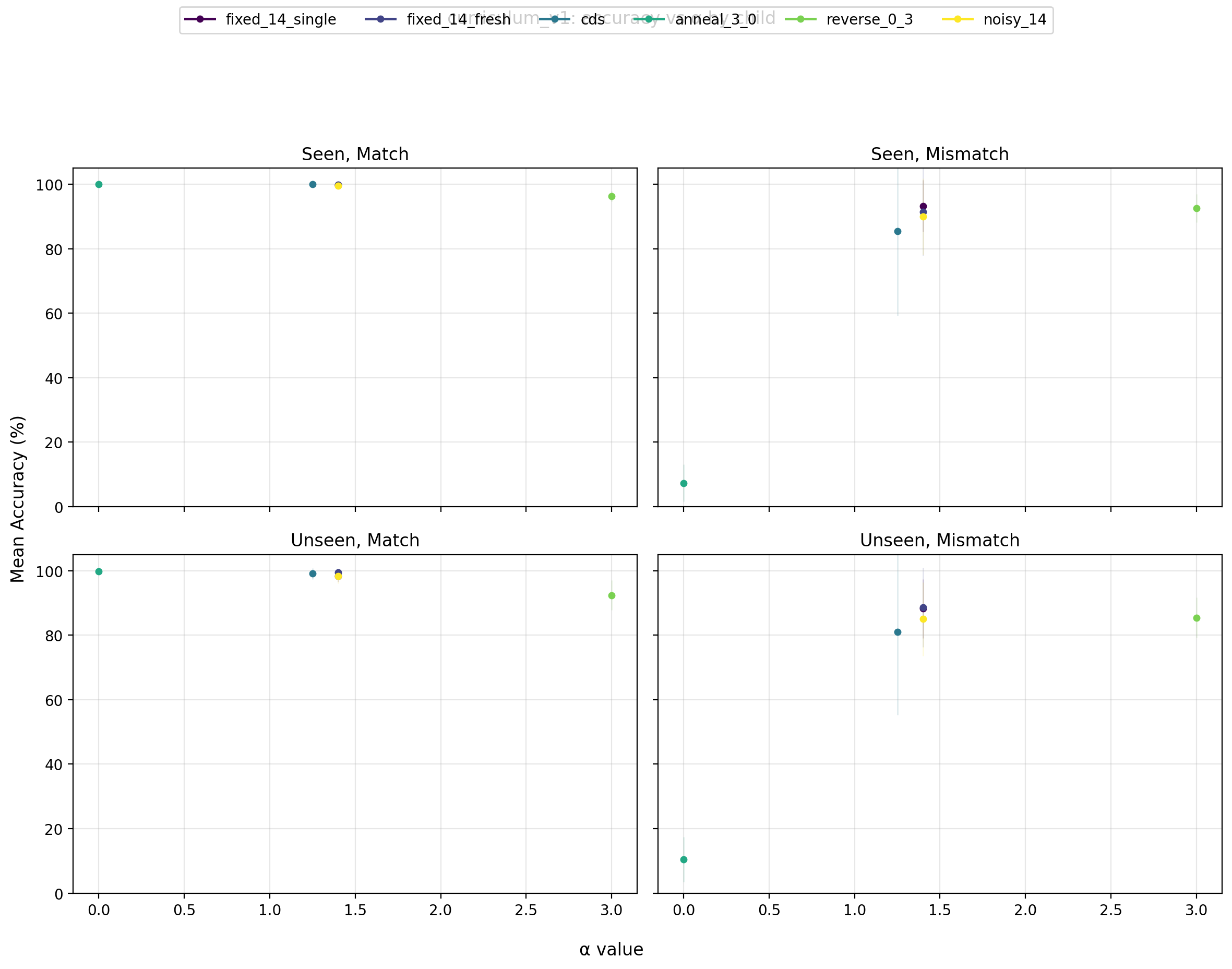
Evaluation data: seen_* probed at reference α = 1.4 · unseen_* = held-out pairings, uniform (α-independent) · 1000 pairs per condition
- Each probe is a minimal pair: a grammatical sentence and its verb-number-flipped twin. The model scores correct when it assigns the grammatical version higher probability; accuracy = % correct over 1000 pairs per condition.
- seen_match / seen_mismatch — noun–verb pairings that occur in training, sampled at fixed reference α = 1.4 (not at the schedule's own α, so arms stay comparable)
- @α conditions (e.g. seen_match@0) — the same seen probes regenerated at reference α = 0, 0.7, 2.1, 3
- unseen_match / unseen_mismatch — held-out noun–verb pairings that never occur in training, sampled uniformly (α = 0), so their difficulty is identical across all arms and training αs
- match vs mismatch — whether the prepositional objects agree in number with the subject; mismatch places attractor nouns between subject and verb (the AGREE-RECENT trap)
| arm | end of training (t = 1200) | per-seed | flags |
|---|---|---|---|
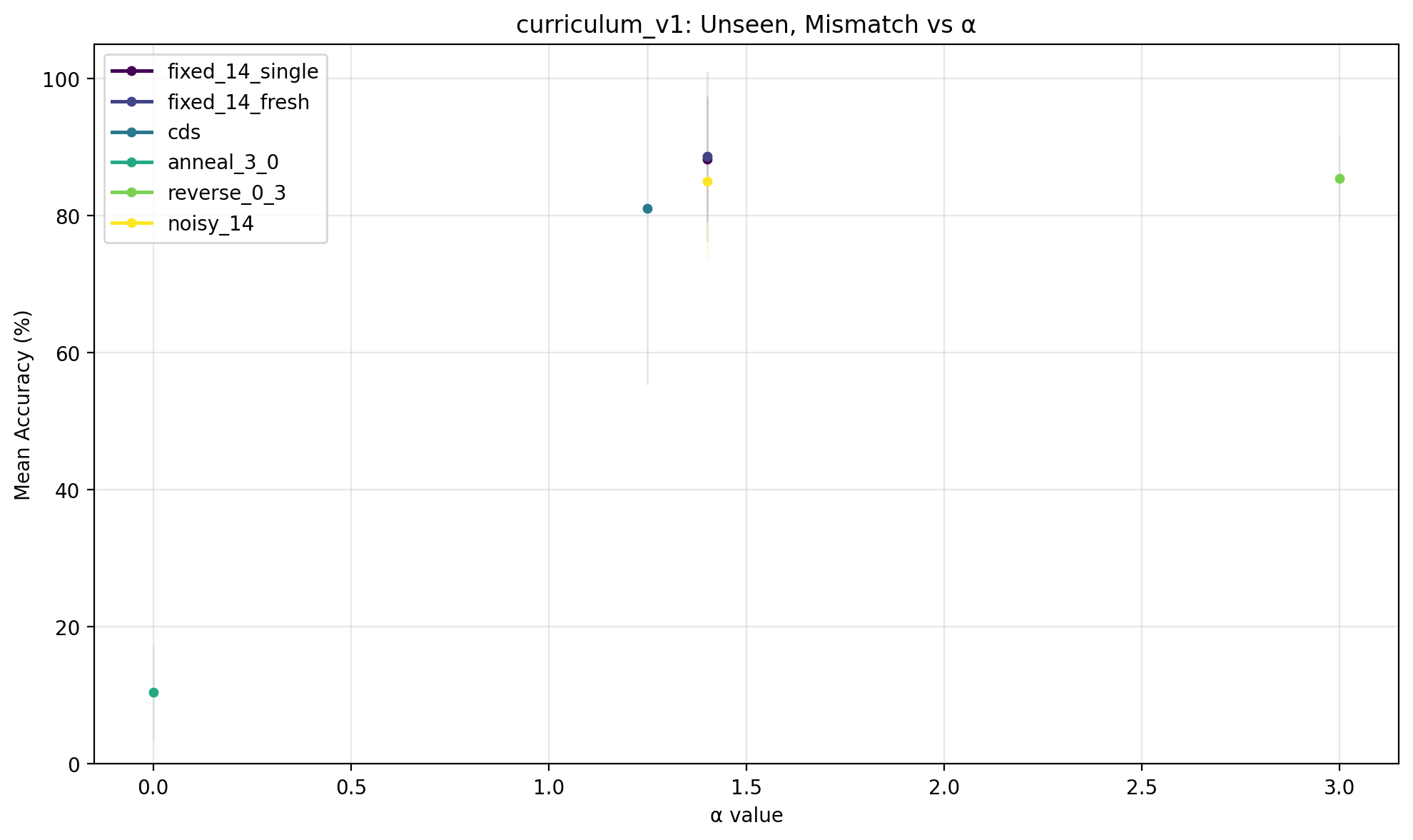
| anneal_3_0 | 10.4 ±7.0 | ||
| cds | 81.0 ±25.6 | ⚠ seed_split: range 7.6-97.9 (1 low / 5 high of 10) | |
| fixed_14_fresh | 88.6 ±12.4 | ⚠ seed_split: range 52.1-96.7 (1 low / 9 high of 10) | |
| fixed_14_single | 88.2 ±9.1 | ||
| noisy_14 | 85.0 ±11.4 | ||
| reverse_0_3 | 85.4 ±6.2 |
Conclusions
The headline hypothesis is rejected at the 1200-step endpoint, but the mechanism it proposed is half-vindicated earlier in training, and the way it fails is more informative than a clean win would have been.
At the end of training, mean unseen_mismatch over the ten
replicates is 88.2 ±9.1 for fixed_14_single, 88.6
±12.4 for fixed_14_fresh, 81.0 ±25.6 for cds, 10.4 ±7.0
for anneal_3_0, 85.4 ±6.2 for reverse_0_3, and 85.0
±11.4 for noisy_14. No curriculum arm beats the fixed
baseline at 1200 steps, and the strong curriculum, anneal_3_0,
finishes far below it.
The mechanism does work early. The waypoints show
anneal_3_0 reaching 90.5 mean unseen_mismatch by step 300,
while both fixed-α = 1.4 arms are near 45 at that point; by step
750 it leads the baseline on both the mean (88.2 against 70.8) and the worst
seed (76.8 against 5.7).
Peaked-first training learns to agree with the subject faster, and far more consistently across seeds, than a fixed α = 1.4 at the same training budget. Collocational bootstrapping accelerates acquisition, as predicted.
Referenced by (1 direct, 1 transitive)
Direct references:
Transitive (depth 1):
What the hypothesis missed is that the uniform tail then undoes the rule. As
anneal_3_0 continues below α ≈ 0.9, every seed collapses: final
per-seed unseen_mismatch lands between 0.3 and 20.0, below the 50 chance
line, which means the models have switched to agreeing with the
nearest noun, and seen_mismatch collapses to 7.3 as well. This is
interference from the late uniform data, not
a failure to learn, because the rule was measurably present first: the same
arm's waypoints run 88.2 at step 750, 24.9 at 1050, and 10.4 at 1200 as the
schedule passes from α ≈ 0.4 down to 0.0.
Training that starts at high pairing concentration builds the
agreement rule early (anneal_3_0 reaches 90.5 mean unseen_mismatch
by step 300 while the fixed α = 1.4 arms sit near 45), and continued
training near uniform then erases it, the same arm collapsing to 10.4 by
step 1200 as its models switch to agreeing with the nearest
noun. The two directions are asymmetric: a peaked tail does not
undo what a uniform start built, but a uniform tail undoes what a peaked
start built.
Referenced by (13 direct, 4 transitive)
Direct references:
- burst_v1
- Three questions about α bursts
- What curriculum_v1 established
- Outcomes track a running balance of build against erosion
- Continuing burst_v1's winning prefix
- Erosion without a uniform tail
- Below P = 3 the schedule fails as a phase transition
- Three prior results shape the prediction
- The floor sets the height and the start sets the timing
- Deep valleys erode the endpoint, not the reachable peak
- Onset speed is paid for in the tail
- The build-and-erode account
- Build early, avoid the uniform tail, and land in the working range
cds sits at the baseline but with more spread. Nine of its ten
seeds finish between 74.8 and 97.9, and one collapses to 7.6. Its αs stay
between 1.23 and 1.46 and never enter the deep-uniform range, so the
realistic developmental drift neither helps nor hurts at this budget, which
is consistent with the damage being specific to sustained near-uniform
exposure.
The anti-curriculum is not the failure the strong-curriculum story predicts.
reverse_0_3 ends at α = 3.0 and holds 85.4 ±6.2
unseen_mismatch, the tightest spread of any arm, along with 92.6 on
seen_mismatch. Early uniform exposure appears to confer a durable ability
to generalize that survives more than 150 steps of nearly one-to-one data at
the end.
Referenced by (1 direct, 1 transitive)
Direct references:
Transitive (depth 1):
The two directions are asymmetric: a peaked tail does not erase the abstraction a uniform start built, but a uniform tail does erase the verb-to-subject cue a peaked start built.
The controls behave. fixed_14_fresh matches
fixed_14_single, so drawing fresh data each stage is not on its
own an advantage and there is no data-diversity confound to explain a
curriculum effect. noisy_14 finishes just below the baseline, so
jitter without a trend does not help.
Follow-ups this suggests:
- A truncated anneal that descends from 3.0 to about 1.2 and then holds, which is the schedule the mid-run numbers say should win outright.
- A sweep of the final-stage α over 0 to 0.9 to locate the threshold where the rule begins to be lost.
- α-burst mixing (issue #3): whether brief uniform exposure hurts, or only sustained exposure does.
- Whether
anneal_3_0recovers if training continues at a moderate α, usingimsyn run continueon its waypoint checkpoints.
Comparison figures
Children
| Child | peak unseen_mismatch | Status |
|---|---|---|
| fixed_14_single | 88.3 | done |
| fixed_14_fresh | 88.6 | done |
| cds | 81.0 | done |
| anneal_3_0 | 90.5 | done |
| reverse_0_3 | 86.9 | done |
| noisy_14 | 88.9 | done |